Mouse control in Utrecht: recognising the signs
You will rarely see mice during the day, as they are mainly active at night. What they leave behind is easier to spot, especially in the kitchen, the meter cupboard and the crawl space.
- small dark droppings, roughly the size of a grain of rice
- gnaw marks on packaging, skirting boards or cables
- a sharp, musty smell of urine in cupboards
- nesting material made of paper, fabric or insulation
- scratching or scurrying in the ceiling or walls when the house is quiet
If you see one mouse, there are usually more. Mice breed quickly, so a small problem soon grows if nothing is done.
How mice get into your home
A house mouse needs an opening of only about 6 mm. That might be a gap under an outside door, a hole around the washing machine outlet or an open weep hole. Once inside, mice use pipe boxing, the cavity wall and the space behind kitchen units as a motorway to wherever food is kept.
In autumn, as it turns colder outside, they are more likely to seek out the warmth of houses. Bird seed, an open bag of dog food or crumbs under the dishwasher then keep them indoors. Rats sometimes use the same routes. If the damage is heavier or the droppings are noticeably larger, take a look at our page on rat control.
Our approach to mouse control, step by step
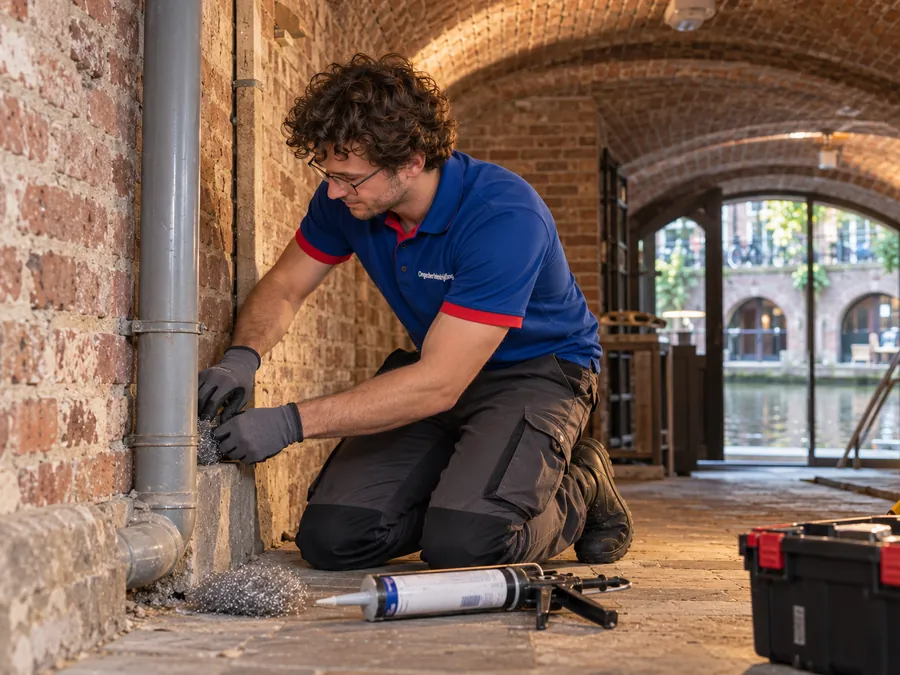
Professional mouse control begins with an inspection inside and out. We follow droppings and grease marks back to the point where the mice get in, often in the crawl space or where pipes pass through walls. We seal those openings with materials mice cannot gnaw through, such as steel wool with sealant, metal mesh or mortar. An open weep hole is not filled in but fitted with a grille, so the cavity can still breathe.
Only then do we deal with the mice already inside, using snap traps or, where needed, professional bait in locked bait boxes. Such products may only be used by certified pest controllers. On a follow-up visit we check whether there is still any activity. To see how we handle other pests, visit our main page on pest control in Utrecht.
What to do yourself, and what to avoid
A few simple snap traps along the wall, baited with a little peanut butter, will often catch the odd mouse. Place them where you find droppings, at right angles to the skirting board and out of reach of children and pets. Keep food and pet food in containers with tight lids.
We advise against glue boards: they are cruel and rarely solve anything. Do not put down poison pellets yourself either. A poisoned mouse often dies somewhere you cannot reach, under the floor or in the cavity, and the smell lingers. If new mice keep appearing, there is still an opening somewhere and professional help is needed.
Keeping mice out
Prevention is mostly a matter of sealing and tidying. A few times a year, check where pipes enter the walls, the crawl-space hatch and the bottom of your doors. A brush strip under the back door and fine mesh behind air vents stop mice without blocking ventilation.
Leave the kitchen bare at night: no open bread bag and no bowl of cat food on the floor. Do not leave rubbish bags on the balcony or in the shed; put them straight into the container. In the garden, hang bird seed in a feeder rather than scattering it on the ground. The less there is to find, the less reason mice have to stay.